
Why we started at microscale, and why computation was just the beginning
The most successful manufacturing system in human history builds exactly one kind of machine.
Semiconductor fabrication gave us the transistor, the microprocessor, the memory chip, the image sensor: the entire substrate of the digital age. Surely that’s many kinds of machines?
It isn’t. It’s one kind, built trillions of times, and understanding why is the key to seeing one of the largest manufacturing opportunities of the next several decades.
What a machine actually is
Ask an engineer what a machine is and you’ll usually get the mechanical answer: a power source drives actuators, and mechanisms (gears, linkages, springs) shape that power into useful force and motion. A bicycle. A pump. A robot arm.
But that definition is a special case of something more general. Strip away the specifics and every machine ever built does three things:
It transduces. It converts energy or matter from one form into another. A motor turns current into torque. A cathode turns voltage into a beam of electrons. A pump turns rotation into pressure.
It shapes flow through engineered geometry. Gear teeth shape a flow of mechanical power. A nozzle shapes a flow of fluid. A waveguide shapes a flow of photons. An electrode shapes a flow of ions.
And its flow is directed, sensed and controlled toward a purpose. Here’s the part engineers know but definitions usually miss: the intelligence that does the directing doesn’t have to live inside the machine, and historically it usually hasn’t. Watt’s governor was bolted onto the engine. The thermostat sits on a wall across the room from the furnace. The bicycle borrows its rider’s nervous system. A machine without direction is a sculpture; but whether the direction is built in, wrapped around, or borrowed is an engineering choice, not part of what makes it a machine.
Transduce, shape, direct. That triad is a machine, and it doesn’t care which physical domain the flow lives in. There are seven such domains: mechanical (force and motion), fluidic (liquids and gases), thermal (heat), electromagnetic and optical (fields and light propagating through space), charged-particle (electrons and ions in vacuum), chemical (matter undergoing transformation), and electrical (charge flowing through circuits), the one domain whose story you already know, though perhaps not as a story about machines. A machine can live in any of them, and the most interesting machines couple several together.
Computers are machines too
Where do computers fit? Squarely inside this definition. A transistor is a valve: a small signal at the gate modulates a flow of electrons through a channel, the same way a pilot valve gates a hydraulic line, the same way a control grid gated the electron beam in a vacuum tube, which, remember, is where electronics actually began. A chip is billions of these valves plumbed together.
What makes computation special is the purpose of the flow rather than its domain. In most machines, the flow itself is the payload: you want the torque, the pressure, the heat moved, the watts delivered. In a computer, the energy in the flow is pure overhead (that’s why we fight to minimize every femtojoule) and the payload is the pattern of the flow across space and time. Information.
So the space of all machines has two axes. One axis is the physical domain of the flow. The other is the purpose: machines that deliver energy and matter, and machines that encode information. Lay those axes out as a grid, place each machine by what it delivers, and every device humanity has ever built occupies a cell somewhere on it.
Now here’s the punchline. Semiconductor manufacturing, the most precise industrial process our species has ever operated, is hyper-optimized for one cell of that grid: the electrical domain, information purpose.
A miracle, but a narrow one
This wasn’t an accident of history so much as a consequence of physics and economics reinforcing each other. Information machines are the most forgiving corner of the grid. When only the pattern matters, you want everything that chip fabrication imposes: one exquisitely characterized material system, quasi-planar geometry, vanishingly small flows, a single physical domain. Smaller and flatter means more valves per dollar, and more valves per dollar means more computation. The constraints of the tool and the needs of the product pointed the same direction, and sixty years of compounding followed.
Machines with an energy purpose are the opposite case. Physics hands them requirements that planar silicon resists: the materials full-size machines are made of, where the job demands them (magnetic cores, thermal mass, real current-carrying cross-section), true three-dimensional geometry, and materials chosen for the domain rather than for the fab. A micro-pump wants channels and chambers. A thermal machine wants materials with wildly different conductivities in intimate contact. A vacuum-electronic device wants emitters, grids, and a sealed cavity. None of that is what a CMOS line was born to do.
Which explains the curious history of MEMS, the micro-electro-mechanical systems field that has spent forty years coaxing chip fabs into building tiny machines. Look across the grid and you’ll find the fab’s footholds in fully half the cells, most of them MEMS: the accelerometers and gyroscopes in your phone, micro-mirrors, inkjet nozzles, microphone diaphragms, thermal cameras, the blood-chemistry cartridges in an ER handheld. Genuine marvels, and their breadth is the point, as is their shallowness. Every foothold is some version of the same trick: a quasi-planar structure in the fab’s own materials, coaxed from tools designed for something else, each device class demanding its own years-long custom process. “One product, one process,” as the field’s own maxim puts it. The footholds prove that demand is real in nearly every domain of the grid. And every one of them stopped at the same wall: missing materials full-size machines are made of, no magnetics, no real force, no sustained pressure, no true third dimension. MEMS is not the set of micro-machines the world needs. It is the set that happened to be expressible on tools built for the transistor.
The rest of the grid, the deep interior of nearly every cell and several cells entirely, has never been buildable at microscale. Not because the physics forbids it. Because no manufacturing system existed to build it.
Why microscale, and why now
What comes next is the extension of micro-manufacturing from that one mastered corner, and its scattered footholds, to the whole of the grid: micro-machines in every domain, in whatever materials the physics wants, in true 3D. And something else happens when machines arrive at this scale. The one cell we did master is the one that thinks. Compute already lives at microscale; what has been missing is a body for it to direct. Build the machines at the same scale and the loop that once ran across a room, or through a rider, closes inside a package: a micro-machine senses the flow, the mastered cell processes it, a micro-machine acts on it, and the whole loop is microns long. Whether the compute shares the die or sits beside it is a packaging decision; either way it is finally where the machine is. The bicycle borrowed its rider’s nervous system. The machines that come next are built where the compute already lives.
Why start at microscale rather than anywhere else on the size spectrum? Three reasons.
The physics is on your side. Scaling laws are kind to small machines. Surface forces come to dominate inertial ones; thermal time constants shrink to microseconds; mechanical resonances climb into ranges where devices respond faster than anything at human scale can; power densities that would melt a macro machine become manageable when the heat has micrometers to travel. Whole device categories work better small. That isn’t a compromise; it’s the prize.
The economics compound. Microscale is where manufacturing becomes a printing problem: thousands of devices per batch, marginal cost falling toward materials, precision delivered by the process rather than by craftsmen. It’s the same economic engine that made transistors effectively free, and it has never been applied to the rest of the grid.
The territory is sparse. At macro scale, every domain of machine already has mature industries, supply chains, and a century of incumbent optimization. At microscale, outside the computation corner, there are footholds and little more: an entire universe of buildable, useful devices with no manufacturer. Nowhere else in engineering is the gap between what physics permits and what industry can produce so purely a manufacturing problem: at microscale the physics is settled and the designs are known, and what’s missing is only the means to build them.
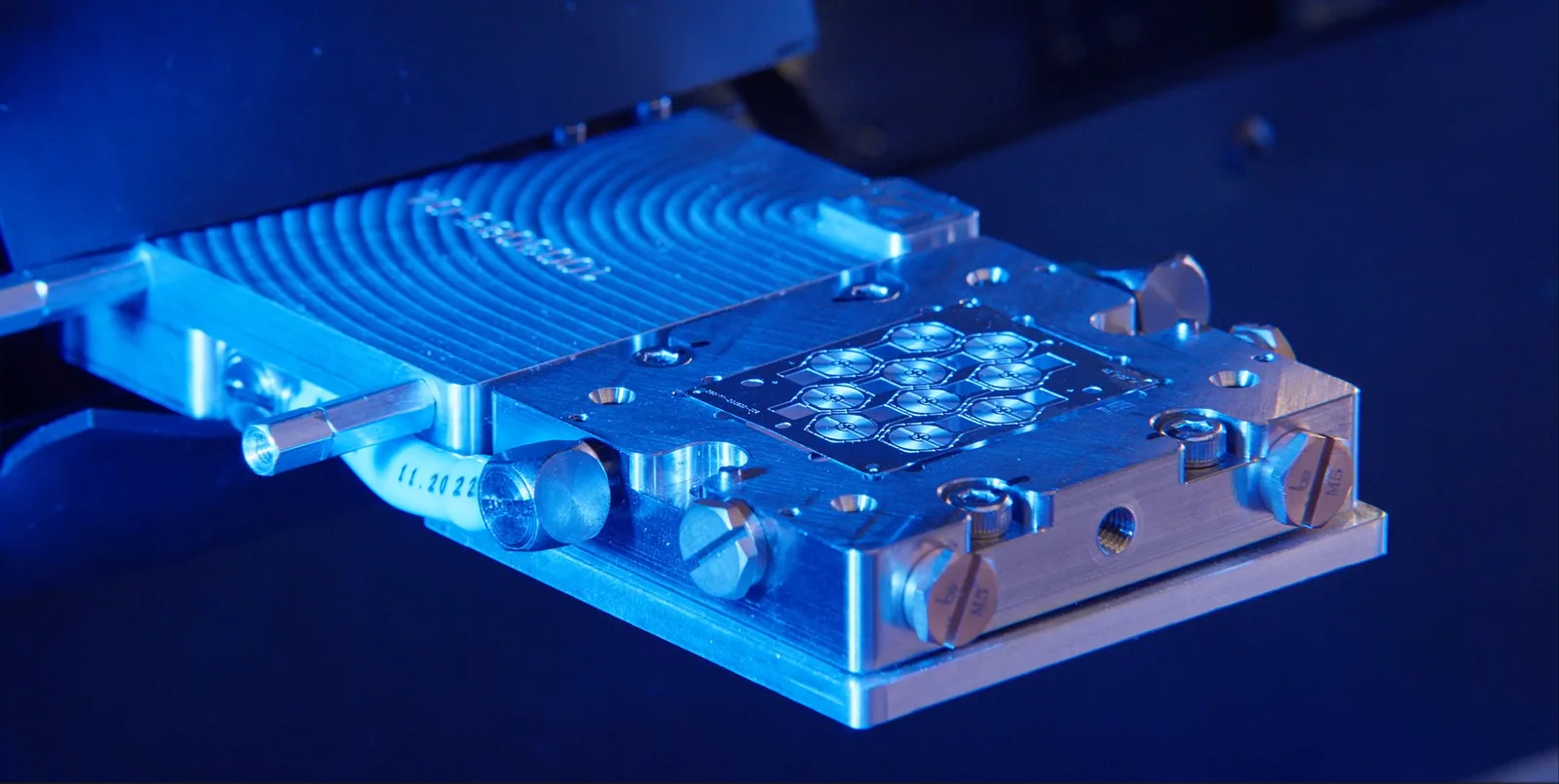
Gaps like this are why Atomic Machines exists. Our mission is a manufacturing system that can build any machine physics permits, and the micro-machine universe is where that mission begins: the gap is purest here, and it is why now. We spent six years building a manufacturing system designed from a blank sheet for exactly this. We call it the Matter Compiler: an AI-native, all-digital, many-process, many-material micro-manufacturing system, the machine that builds the machines the fab never could.
The shape of what’s coming
The grid on our site carries examples cell by cell, and they are worth a look, but they are illustrations rather than a catalog. A definition that devolves into a list has failed, and the honest answer is that the most important devices in a sparse territory are the ones nobody has designed yet, just as nobody staring at the first planar transistor in 1959 predicted the smartphone. But the categories are visible from the grid itself: machines that move fluids and analyze chemistry at the point of need; machines that manage heat actively instead of passively; machines that generate, steer, and sense beams and fields; machines that carry real power through metal rather than silicon; machines that assemble, manipulate, and measure the physical world at the scale where biology and technology meet.
One of those categories already has its first entry. PrimeSwitch, the first micro-machine produced by the Matter Compiler, is an electromechanical power relay that opens in 50 microseconds, about a thousand times faster than a conventional contactor. It lives in the electrical domain, energy purpose: the cell where the grid’s deepest foothold stopped. It is built from the conjunction the fab could never manage: micron-scale features, the metals and alloys of full-size machines, and three-dimensional assembly of moving parts.
Computation digitized information and remade the world. It occupied one cell of the grid.
The other cells are where the physical world gets its turn.
Atomic Machines built the manufacturing system for the rest of the machine universe, and PrimeSwitch is the first machine out of it.
Blog